Skip to content

Proof sample

Sample verified remediation record

A verified remediation record proves that a specific finding no longer applies to a new artifact, using independent corroboration evaluated against versioned policy.

This is a synthetic example for illustration.

What this artifact proves

  • The original finding and the exact artifact in which it was detected.
  • Independent retest evidence showing the finding is no longer present in the new artifact.
  • Corroboration from a reviewer attestation and runtime telemetry, where policy requires it.
  • That the verification was bound to a specific policy version and can be replayed.

What this artifact does not prove

  • That all risk in the system has been retired.
  • That the same vulnerability cannot be reintroduced in a future change.
  • That the absence of scanner findings means the code is unconditionally safe.
  • That downstream consumers of the artifact have verified the same finding.

Artifact fields

FieldRole
evidence_snapshotThe original finding, retest results, and corroboration.
policy_versionThe policy that defined what counts as verified remediation.
policy_digestDigest of the policy version used for verification.
decision_fingerprintUnique identifier for the remediation decision.
freshness_stateWhether the retest evidence was within the policy freshness window.
trust_stateQualification state, such as qualified_and_corroborated.
dsse_envelopeSigning status protecting the record.
downgrade_reason_codesRecords explicit acceptance instead of verified fix.
outcomeHonest outcome, such as risk_absent, risk_present, or indeterminate.
replay_commandCommand to reproduce the remediation verification.
runtime_corroborationIndependent runtime evidence supporting the retest conclusion.
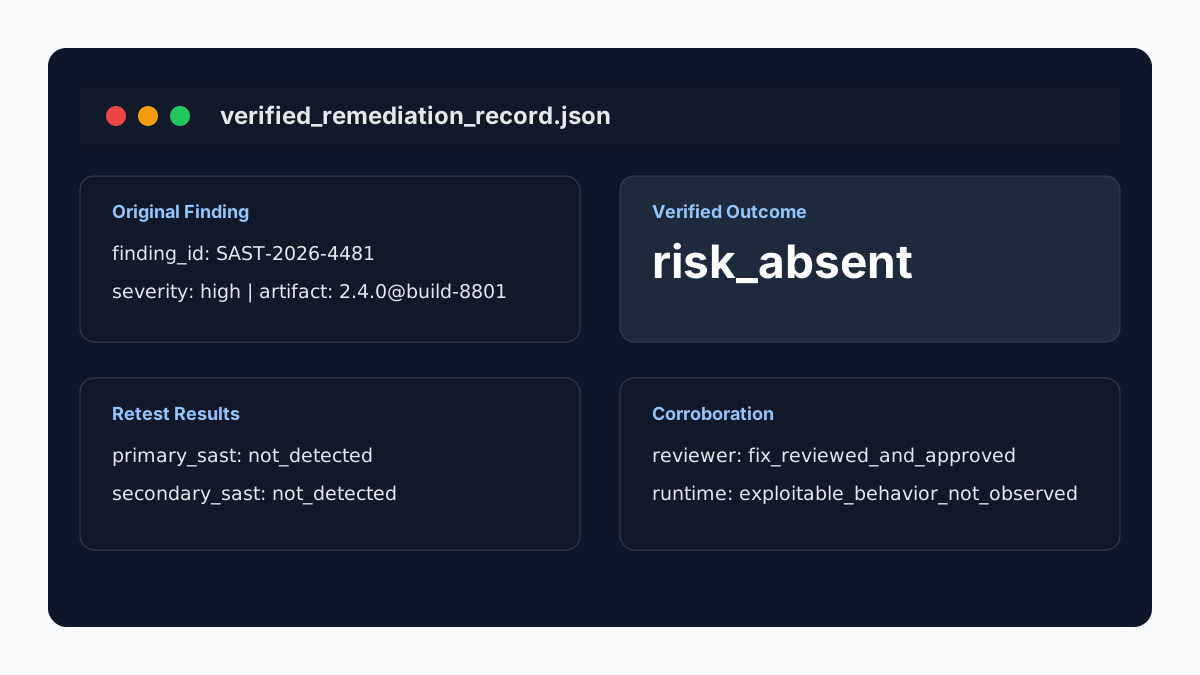
Screenshot-style preview of a sample verified remediation record

Synthetic verified remediation record (JSON)

{
  "artifact_type": "verified_remediation_record",
  "evidence_snapshot": {
    "original_finding": {
      "finding_id": "SAST-2026-4481",
      "tool": "primary_sast",
      "severity": "high",
      "location": "src/payment/validator.ts:112",
      "description": "Unsafe deserialization in payment validator",
      "detected_in_artifact": "payment-service:2.4.0@build-8801"
    },
    "fix_artifact": "payment-service:2.4.1@build-8842",
    "retest_results": [
      {
        "tool": "primary_sast",
        "finding_id": "SAST-2026-4481",
        "status": "not_detected"
      },
      {
        "tool": "secondary_sast",
        "finding_id": "SAST-2026-4481-retest",
        "status": "not_detected"
      }
    ],
    "reviewer_attestation": {
      "reviewer": "jsingh@example.org",
      "conclusion": "fix_reviewed_and_approved",
      "reviewed_at": "2026-07-20T10:15:00Z"
    },
    "runtime_corroboration": {
      "source": "runtime_telemetry",
      "status": "exploitable_behavior_not_observed",
      "observed_at": "2026-07-20T11:00:00Z"
    }
  },
  "policy_version": "v1.3.2",
  "policy_digest": "sha256:a1b2c3...f4e5d6",
  "decision_fingerprint": "sha256:3d4e5f...2c1b0a",
  "freshness_state": "fresh",
  "trust_state": "qualified_and_corroborated",
  "dsse_envelope": {
    "payload_type": "application/vnd.gosentrix.remediation+json",
    "signatures": [
      {
        "keyid": "remediation-signer-2026",
        "sig": "..."
      }
    ]
  },
  "downgrade_reason_codes": [],
  "outcome": "risk_absent",
  "replay_command": "gosentrix replay --remediation-id SAST-2026-4481 --fix-artifact payment-service:2.4.1@build-8842 --policy-version v1.3.2"
}

How this maps to the GoSentrix doctrine

Risk state, not ticket state

The outcome records whether risk is absent, present, or indeterminate—not whether a ticket was closed.

Independent corroboration

Retest plus reviewer attestation plus runtime telemetry reduces reliance on any single claim.

Policy-bound verification

policy_version and policy_digest bind the conclusion to the rules in force at the time.

Explicit downgrade handling

downgrade_reason_codes separate accepted risk from verified remediation.

Frequently asked questions

What is a verified remediation record?

A verified remediation record is evidence that a specific finding no longer applies to a new artifact. It includes the original finding, the retest result, corroborating evidence, and the policy version that defined what counts as verified.

Why is independent corroboration required?

A single scanner retest may be wrong or incomplete. Independent corroboration—such as a second scanner, reviewer attestation, or runtime telemetry—raises confidence that the risk was actually retired.

Verified fixes, not just closed tickets.

GoSentrix produces remediation records that link original findings, independent retests, and policy versions so fixes are provable.